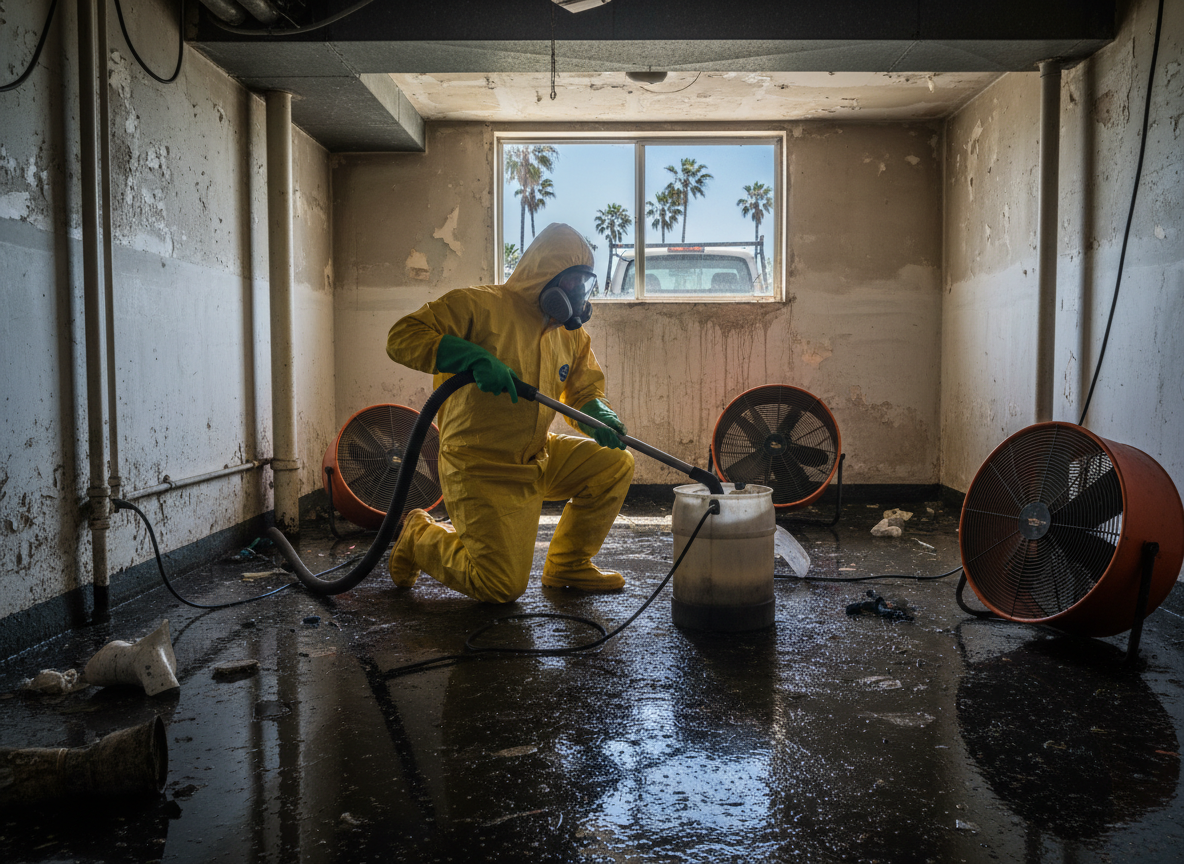
Sewage backups in La Jolla often trace to aging clay or cast-iron lines in homes built before 1970, especially in Muirlands and Upper La Jolla where tree roots from mature landscaping invade joints. The mild Mediterranean climate keeps most pipes stable, yet rare winter storms can overwhelm older municipal lines near La Jolla Shores Beach and Scripps Pier, pushing effluent into crawl spaces and garages. Technicians must separate gray water from black water quickly because coastal humidity slows evaporation and raises the risk of mold on drywall and subfloors within 48 hours.
Work in neighborhoods like Windansea and Torrey Pines requires extra containment because many lots sit on slopes that drain toward the ocean or UC San Diego campus. Negative-air machines and antimicrobial application follow IICRC S500 protocols; any porous material contacted by Category 3 water is removed rather than dried. Homeowners near Mount Soledad frequently discover hidden damage behind finished basements when a main line clogs, so moisture meters and infrared scans are used on every job before final clearance.
Local Pipe and Terrain Factors
Older gravity lines in Bird Rock and La Jolla Village run under narrow streets with limited access, so crews often need to coordinate with city permits for excavation. Salt air accelerates corrosion on metal cleanouts, and the high water table near the cove can cause repeated intrusion if the cleanout is not raised or sealed properly.
Safety and Containment Steps
Technicians wear full PPE and establish physical barriers to protect unaffected rooms. All extracted waste is hauled to permitted San Diego County facilities; no rinsing occurs on-site that could reach storm drains leading to La Jolla Shores Beach.
Technician insight
In La Jolla, the thing that catches most people out with sewage cleanup is the older clay laterals under homes in the Muirlands and around Mount Soledad; one storm surge or root intrusion can send effluent under finished floors that look dry from above because the coastal clay soil holds moisture for weeks.
La Jolla Shores Backup After Winter Rain
A main line clogged during a rare heavy rain pushed sewage into the garage and laundry room of a 1960s home near La Jolla Shores Beach. Crews found water had wicked six feet up the drywall and under the slab. They extracted 400 gallons, removed saturated base plates, treated the subfloor, and dried the space over five days so the owners could resume use without odor or health risk.
How it works
- 1
Arrival and Assessment
Technician arrives within two hours, identifies the source, maps affected rooms, and sets up containment using plastic barriers and negative pressure.
- 2
Extraction
Standing water and solid waste are removed with truck-mounted pumps and wet vacuums; all visible debris is bagged for off-site disposal.
- 3
Cleaning and Disinfection
Non-porous surfaces receive EPA-registered disinfectants; antimicrobial fogging treats cavities and subfloors.
- 4
Drying and Monitoring
Air movers and dehumidifiers run until moisture readings match unaffected materials; daily logs track progress.
- 5
Final Clearance
Independent verification confirms no remaining contaminants before reconstruction begins.
Pricing
Pricing varies by volume, affected square footage, and whether structural materials must be removed; every job receives an on-site written quote before work begins.